
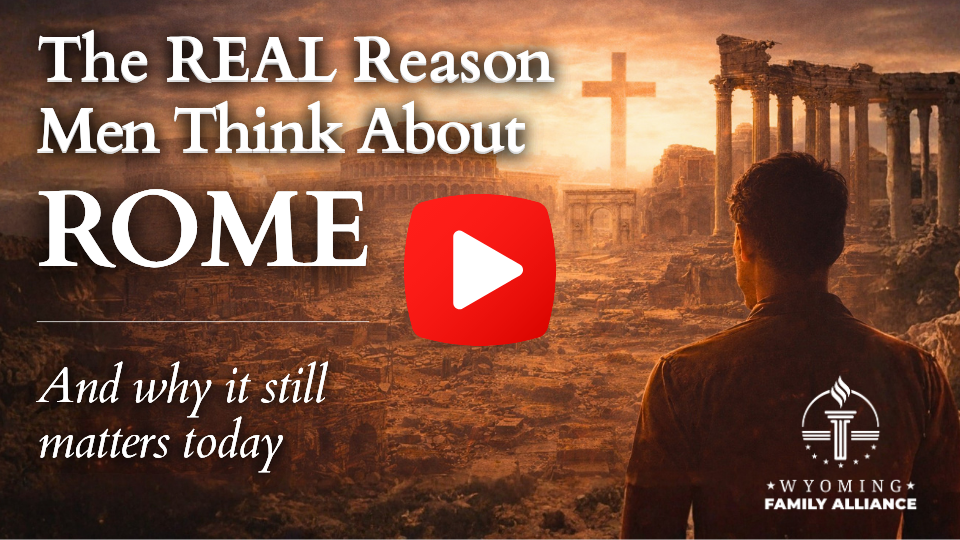
by Nathan Winters, Wyoming Family Alliance President & CEO
CLICK HERE to watch the video (4 min. 47 sec.)
Or read the transcript below.
A popular question circulated around the internet a while back: Men were asked how often they think about ancient Rome.
And what was so interesting was not only how often men think of Rome, but how many were amazed at how this question could turn men into philosophers.
Sadly, I did hear one very left-leaning woman attempt to downplay how men respond so seriously by declaring that men are somehow fixated—and I’ll paraphrase—on swords, sand, and sandals. And I think that says more about her leftward bias than it does anything else.
But in truth, most men take this question seriously because, for many of us, ancient Rome isn’t just a civilization of the past. It’s a mirror into the present; it also provides a warning for the future.
Rome speaks to the soul of Western man because it was the soul of Western civilization for over a thousand years. We live in a world that inherited its roads, its language, its laws, its glory, and the aftershocks of its downfall.
Now, to a Christian man, Rome matters not just for what it built, but also for what it failed to build.
It had strength without righteousness, order without mercy. It had power without humility. Rome gave us the idea of civitas, of public life rooted in duty and in discipline.
And yet, it also crucified the Son of God.
The same empire that codified laws, perfected roads, and built a Pax Romana, enslaved millions and persecuted Christians. Eventually, it collapsed under the weight of its own decadence.
And deeper still is why Christian men think of Rome: because the New Testament was written in a Roman world.
Paul wrote to churches under Roman occupation. Jesus was born under Roman rule. The gospel spread on Roman roads and was proclaimed under Roman law.
Rome raised banners, it forged its weapons, it worshiped its emperors, but it didn’t know what to do with a king who was willing to carry a cross and wear a crown of thorns. The empire that prided itself on peace nailed peace Himself to wood. The civilization that praised justice condemned the only truly innocent man who ever lived.
And even more, Rome is haunting. We look around and we see debauchery and decay, and it’s as though we’ve seen this before.
That’s why many men think of Rome. Rome reminds us that civilizations usually don’t merely fall from without; they often rot from within.
When appetite becomes a god, when ego becomes sacred, when truth is traded for comfort, when you have a culture that seems to bend inward, admiring its own reflection while the foundations are breaking up beneath it.
So yes, men look at Rome and wonder, will we learn from history, or are we doomed to repeat it?
But Rome is not only a warning; Rome is a witness. It reminds us of hope because even in Rome’s darkest hour, the gospel was not silent.
No, instead it sang from prison cells, it echoed in catacombs, it passed from wounded saint to trembling sinner.
And that’s our hope.
So why do Christian men think of Rome? Well, it’s also because we’re called to build something better—not just empires of stone, but legacies of truth.
Because while empires crumble, the gospel remains forever. And because while all roads once led to Rome, all history bends toward a city whose builder and maker is God.
In a Christian man’s heart, he knows that a life well-lived is lived in service to a king who died for every one of his subjects and built a kingdom that will never be shaken.
So yes, we think of Rome, but only so we may remember why we must live for a better kingdom, serve a better king, and build in such a way that when the dust of our age settles, what remains will not be our pride, but our faithfulness.