Elections
The Case for Runoff Elections in Wyoming
Wyoming’s primary decides who governs. This year, three of six contested Republican nominations were won with less than half the vote.
By Gena Konrad-Cone
Director of Operations & Communication
Wyoming Family Alliance
A runoff asks one neutral question: Did a majority of voters in a party’s primary choose its nominee?
In Wyoming, the August primary often carries more weight than the November general election. Republicans have won every gubernatorial contest since 2010, and Republican ballots made up 88.3% of all ballots cast in the 2026 primary.
State law requires only a plurality, meaning the largest share of votes rather than a majority. A candidate can therefore win even when most voters in that primary choose someone else.
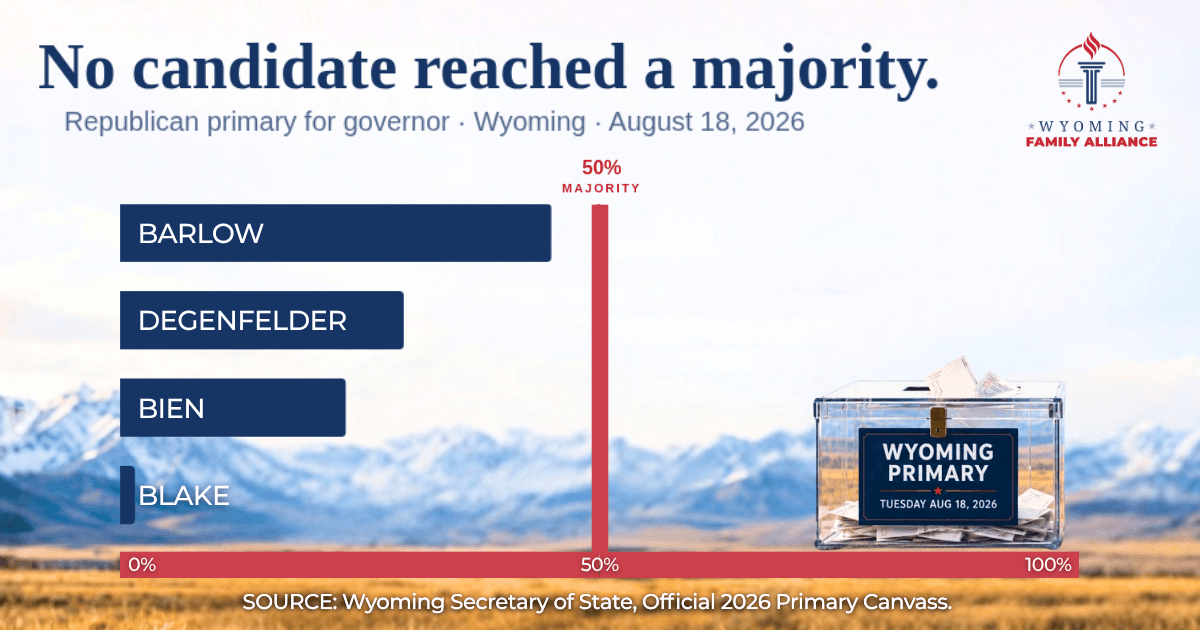
On August 18, Eric Barlow won the Republican nomination for governor with 58,825 votes, about 45% of the votes cast for governor. Megan Degenfelder received 38,746 votes, Brent Bien received 30,850, and Curt Blake received 2,161.
Degenfelder and Bien together received 69,596 votes, 10,771 more than Barlow. For voters who saw Degenfelder and Bien as the more conservative choices, those totals sharpened a familiar frustration: when two candidates draw from the same pool of voters, they split the vote, leaving a third candidate to win without a majority.
Barlow won fairly under Wyoming’s current rules.
The question we are asking is whether those rules should be changed to require majority support.
Higher turnout did not produce a majority
In our August 13th article, “Wyoming’s Real Election Is Tuesday,” we asked Wyoming voters to show up. The reason was in the previous cycle’s numbers.
In 2024, Wyoming cast 122,718 ballots in the August primary and 271,123 in the November general election. More than twice as many people turned out for the November ballot as for the primary that decided who would be on it. We argued that showing up for the 2026 primary to vote is an act of faithful stewardship, not an optional pastime for political hobbyists.
Voters answered statewide, with 150,385 ballots cast on August 18th, equal to 54.9% of registered voters. That was the second-highest turnout rate among the five primary elections held in gubernatorial years from 2010 through 2026.
Wyoming held one of its strongest primaries in sixteen years and still nominated a candidate most primary voters did not choose. And nearly half of registered voters did not vote at all. If past patterns hold, far more Wyomingites will vote in November, in a race the August result had already decided.
The plurality pattern is not new
Wyoming held one of its strongest primaries in sixteen years and still nominated a candidate most primary voters did not choose.
Six statewide and federal Republican nominations were contested on Wyoming’s 2026 primary ballot. Three went to candidates who received less than half of the vote in their races.
Barlow received about 45% in the governor’s race. Robert Short received about 46% for secretary of state. In the nine-candidate U.S. House race, Chuck Gray won with about 25%, meaning roughly three in four voters chose another candidate.
Those results are not criticisms of the nominees. They competed under Wyoming’s current rules and won. The issue is the plurality rule, not any particular candidate.
The other three contested nominations did not present the same problem. Harriet Hageman won the U.S. Senate nomination with about 65%, Curt Meier the treasurer’s race with about 68%, and Steve Harshman the superintendent’s race with about 58%.
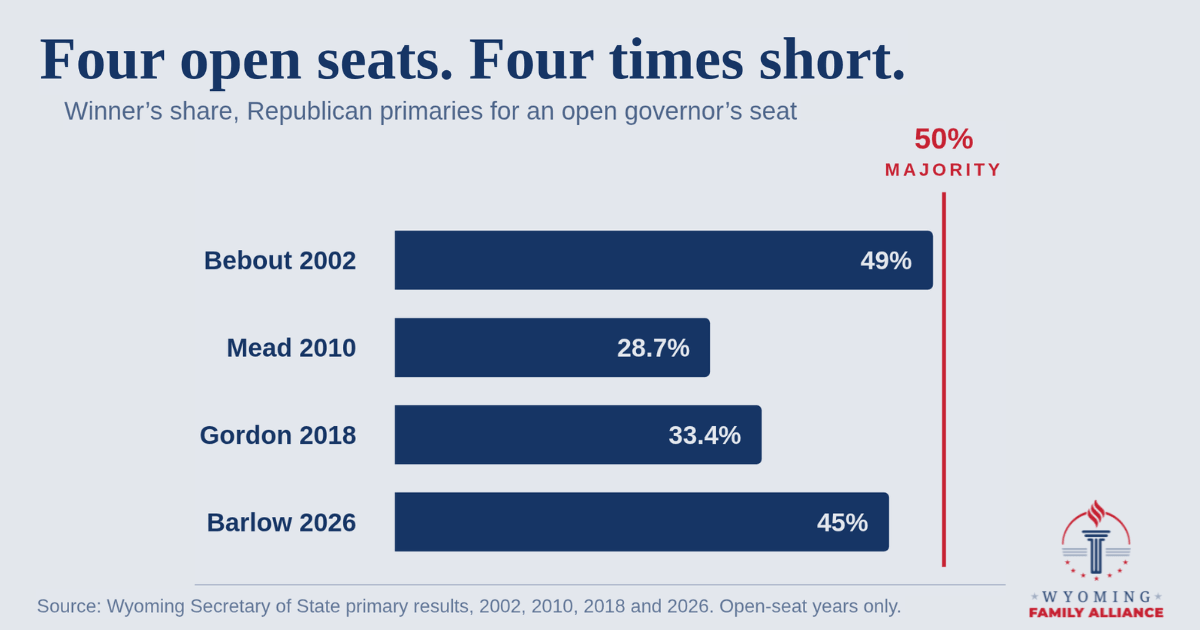
History suggests the plurality results are not a one-cycle anomaly. Wyoming has held four Republican primaries for an open governor’s seat since 2002, and none produced a nominee with majority support.
Eli Bebout received 49% in 2002. Matt Mead received 28.7% in 2010. Mark Gordon received 33.4% in 2018. Barlow received about 45% in 2026, the strongest showing of the four.
Four open seats in 24 years. Yet none received a majority.
What a runoff would do
The mechanism is simple. If no candidate receives more than 50% of the primary vote, the two candidates with the most votes advance to a second round. Voters then choose between them.
Wyoming lawmakers have twice tried to build one. SF0145 in 2021 and HB0249 in 2025 would each have applied a majority requirement to the Republican and Democratic primaries for governor, secretary of state, treasurer, auditor, superintendent of public instruction, U.S. Senate and U.S. House. Both would have moved the first round of voting to May and held any runoff in August, when Wyoming votes now.
A race with a majority winner would end in the first round. In 2026, the Republican contests won by Hageman, Meier and Harshman would not have required a runoff.
Why the runoff would remain party-controlled
Wyoming’s current primary is closed. For the 2026 election, voters who were already registered had to declare or change party affiliation by May 13, the day before candidate filing opened. Newly registering voters could declare an affiliation later. Only voters affiliated with a party may vote that party’s primary ballot.
That deadline is being challenged before the Wyoming Supreme Court, which heard argument in June and has not ruled. However that case comes out, a runoff would remain a second round within the same party’s nomination process.
A neutral rule, written in advance
The strongest fairness objection is that a runoff requirement could be designed to help one faction of a party and hurt another.
Had HB0249 governed the 2026 primary, the two most prominent Republican runoffs would have matched Barlow against Megan Degenfelder for governor and Gray against Steve Friess for U.S. House.
The same threshold would have applied to both races and to every future race covered by the law. Because candidates and coalitions change from one cycle to the next, the Legislature should adopt any threshold prospectively, before anyone knows whom it will help.
Party registration is an imperfect proxy for ideology, and in a state where 88.3% of primary ballots were Republican, that is especially true. It does not change the central question: Should a nominee need support from a majority of the voters who participate in that party’s primary?
A plurality system rewards the candidate who finishes first. A runoff asks one of the top two candidates to assemble a majority among the voters who return. It does not guarantee the better candidate, but it sets a clear and neutral standard for nomination.
The objections, and honest answers
The case for a runoff is stronger when its costs and tradeoffs are stated plainly.
Turnout can fall
FairVote’s analysis of 292 federal primary runoffs held from 1994 through 2024 found that turnout declined in 97% of them, with a median decline of 41%. Among the 16 federal primary runoffs in 2024, the median decline was 63%. The study covers federal primaries, not Wyoming statewide races, but the warning is relevant.
Lower turnout does not predict which candidate will benefit. In the 2012 Texas Republican primary for U.S. Senate, David Dewhurst led Ted Cruz by 10.5 percentage points. The runoff drew 21% fewer votes, and Cruz won by 13.6 points.
That tradeoff is real. A runoff substitutes a majority decision among returning voters for the broader participation of the first round. Any proposal should address that risk directly.
The field narrows
A runoff narrows the ballot to two names by design. That is how it produces a majority choice. It can also narrow the electorate if fewer voters return, which is why the runoff date and how well it is publicized would matter as much as the threshold itself.
The cost is not yet fully known
HB0249’s fiscal note identified $283,186 in one-time changes to Wyoming’s voter-registration and campaign-finance systems. It also said the cost of conducting a statewide runoff was unknown. The bill’s $2 million appropriation was funding for a runoff account, not an estimate of the election’s total cost.
In 2026, only three statewide or federal Republican contests would have advanced to a runoff. Even three would carry the price of opening every polling place in the state. Still, those costs should be weighed against the four-year consequences of choosing nominees without majority support.
A runoff is not ranked-choice voting
Wyoming enacted HB0165 in 2025, prohibiting ranked-choice voting effective July 1, 2025. A conventional runoff works differently: It holds a separate election, presents two finalists, and asks voters to cast a new ballot.
The House passed a runoff bill. The Senate has stopped two.
The idea is not new. A senator carried it in 2021 and a representative carried it in 2025. Both times it reached the Senate. Both times it stopped there.
The Wyoming House passed HB0249 in 2025 by a vote of 38 to 22.
The bill then cleared the Senate Corporations Committee 4 to 1 and Senate Appropriations 3 to 1, with one member excused. Both committees held hearings. Both recommended passage. It reached the Senate general file and was never scheduled for debate. On March 4, Sen. Cheri Steinmetz moved to bring it up. The motion failed 5 to 26, and the bill died with the session. The full Senate never voted on its substance.
It was not the first attempt. In 2021, SF0145 cleared the Senate Corporations and Appropriations committees by votes of 4 to 1, passed Committee of the Whole and second reading, then failed on third reading 14 to 15, with one senator excused. Reconsideration failed 3 to 26, with one senator again excused.
In 2021, the full Senate debated the bill on its merits. One senator warned of an unintended consequence: two contentious majority-party primaries while the minority party “fields a candidate that floats right through,” leaving the runoff winner to reach the general election “broke and exhausted.” Another said constituents “were just appalled that we would have another election.” A third asked for an interim study instead, saying he had “not really heard a great reason for changing 130 years of history yet.”
That first concern deserves a direct answer. In a state where registered Republicans outnumber Democrats by more than seven to one, a bruising Republican runoff is unlikely to hand the office to a Democrat. That is a real risk in a competitive state. Wyoming is not one.
In 2025, no such debate occurred. When Sen. Steinmetz asked the chamber to make floor time for the stalled bill, the objection raised against her motion was about the session calendar, not about runoffs.
What Wyoming should do next
Both times it reached the Senate. Both times it stopped there.
The Wyoming voters who showed up in August did the hard part by voting in the election that often carries the greatest practical weight. They deserve a clear answer about whether the largest share of the vote is enough to nominate candidates for the state’s highest offices, or whether a nominee should have to win more than half.
Wyoming’s registration numbers and electoral history make it overwhelmingly likely that the August Republican primary selected the state’s next governor. As of August 1, registered Republicans outnumbered Democrats by more than seven to one, and no Democrat has won a Wyoming governor’s race since 2006.
If that pattern holds, the next governor will take office after receiving about 45% in the contest that effectively decided the office. That is not a scandal, and it does not call the nominee’s legitimacy into question. It reveals a choice embedded in state law: Wyoming permits nominees to prevail with less than majority support. Lawmakers can keep that rule or write a different one.
The next Legislature should take up the question again and finish the work left undone by setting a neutral majority standard.
The question has reached the Senate twice and gone no further. Find your legislators before the next session begins and tell them you want it heard.
Email your legislatorsSources
Percentages are rounded from official vote totals. Where a race included write-ins or a withdrawn candidate, the article uses “about” to avoid false precision. Quotations from Senate floor debate are drawn from contemporaneous news coverage rather than the Legislature’s official transcript.
Wyoming Family Alliance, “Wyoming’s Real Election Is Tuesday” (Aug. 13, 2026)
Wyoming Secretary of State, 2026 official primary election results
Wyoming Secretary of State, 2026 statewide total ballots cast summary
Wyoming Secretary of State, Aug. 1, 2026 voter-registration statistics
Wyoming Secretary of State, election results archive
Wyoming Secretary of State, voter registration and turnout statistics
Wyoming Secretary of State, 2002 statewide primary results
Wyoming Secretary of State, 2010 statewide primary results
Wyoming Secretary of State, 2018 statewide primary results
Wyoming Legislature, HB0249 (2025), bill history and votes
Wyoming Legislature, HB0249 fiscal note
Wyoming Legislature, SF0145 (2021), bill history and votes
Wyoming Tribune Eagle, Senate third-reading debate on SF0145 (Mar. 24, 2021)
Cowboy State Daily, Senate Corporations hearing on HB0249 (Feb. 26, 2025)
WyoFile, 2025 session election bills
Wyoming Secretary of State, 2026 key election dates
Wyoming Legislature, HB0103 (2023), party-affiliation deadline
WyoFile, Wyoming Supreme Court argument on the party-switching law
FairVote, federal primary runoff turnout analysis, 1994–2024
Texas Secretary of State, 2012 Republican primary results
Texas Secretary of State, 2012 Republican runoff results
Wyoming Legislature, HB0165 (2025), ranked-choice voting prohibition