Aborting Innovation
Wyoming Family Alliance
“I’m pro-life. The only exception would be life of the mother.”
I’ve lost count of how many times I’ve heard that from candidates.
Each time, I wonder the same thing: do they actually believe abortion is the cure, or have they simply never been introduced to the physicians who have spent their careers proving otherwise?
“Life of the mother” has become almost untouchable in our public discourse. Mention it, and the conversation is often over before it began. No one wants to appear indifferent to a woman facing a medical crisis, and rightly so. But those four words hide a world of nuance that raises the question:
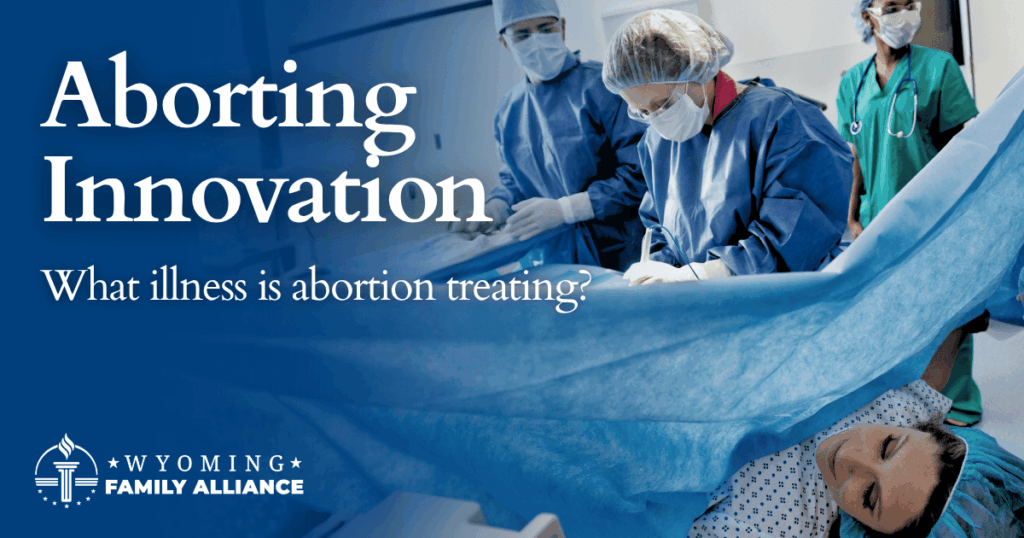
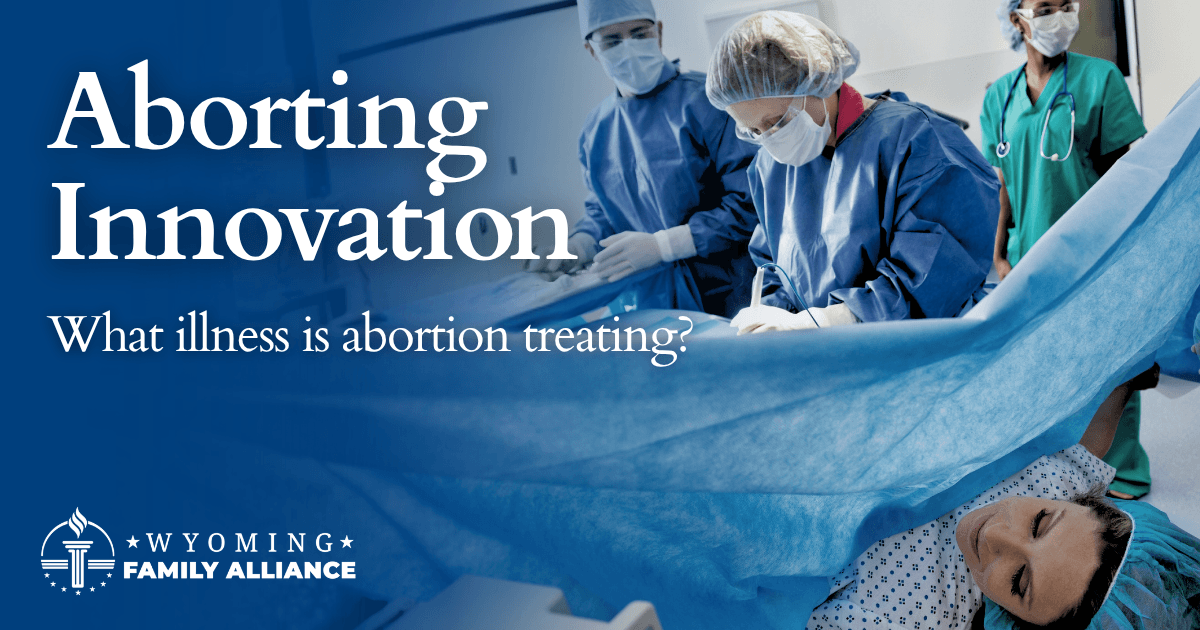
What illness is abortion treating?
Words matter. We are told, over and over, that abortion is healthcare. Healthcare treats disease. It heals injuries. It restores what was broken. If abortion is truly healthcare, we should be able to name the disease it cures.
Pregnancy is not a disease. Abortion is never the cure.
Miscarriage and ectopic care are not abortion
Before going further, let’s clear away two common misconceptions. Miscarriage care is not abortion. It involves removing a child who has already died. Treating an ectopic pregnancy is not abortion either. The American Association of Pro-Life Obstetricians and Gynecologists (AAPLOG) calls this category “medically-indicated maternal-fetal separation,” and draws the line the same way any of us should: not by whether the child survives, but by intent. An abortion aims at the child’s death. A maternal-fetal separation aims at saving the mother’s life from a condition that cannot otherwise be treated.
Conflating those procedures with the intentional killing of an unborn child has done real damage to pro-life discourse. It has convinced many well-meaning people that abortion is the same thing as ordinary pregnancy care. It is not.
When the mother’s life is at risk
The more I have researched, the clearer it becomes that abortion is being taught as standard practice, for an ever-growing list of diagnoses, to physicians historically grounded in the principle of first doing no harm.
Ironically, for a movement that calls itself progressive, progress seems to stop where abortion begins. Medicine has never advanced by accepting the limits of the present. Every breakthrough exists because someone rejected the conclusion, “There’s nothing more we can do.”
Medicine has never advanced by accepting the limits of the present.
That spirit of perseverance is nowhere more evident than in the physicians caring for pregnant mothers facing life-threatening complications.
For decades, a cancer diagnosis during pregnancy came with an assumption few questioned: abortion first, treatment second. Women were told that ending the pregnancy would improve their prognosis and let doctors act more aggressively. That assumption is no longer supported by current evidence. Physicians now assemble multidisciplinary teams of oncologists, obstetricians, surgeons, and neonatologists, built to treat both patients. Many chemotherapy regimens can safely begin after the first trimester. In some cases, treatment can be delayed until after delivery without compromising the mother’s outcome.
One of those mothers is Brionna Johnson. Around seventeen weeks pregnant, she learned she was carrying twenty-seven pounds of fibroid tumors. Multiple physicians told her she needed an abortion, followed by a hysterectomy. She refused and found a doctor willing to try something else. He surgically removed the tumors and was able to preserve her uterus and therefore her future fertility. She is due to give birth this month. Pregnancy was never her illness. The fibroids were.
Lucy Isaac, treated by a fifteen-person team at Oxford University Hospitals, was twelve weeks pregnant when she was diagnosed with ovarian cancer. Rather than asking her to choose between treating her cancer and protecting her son, at twenty-one weeks her surgeons attempted something few would have imagined: they lifted her uterus, her unborn son still safely inside, out of her abdominal cavity, removed the cancerous tissue, and returned the uterus to her body. She later delivered a healthy, full-term baby boy she named Rafferty. The disease was never her son. It was the cancer.
A woman in Poland faced a similar crossroads. Ten weeks pregnant, she developed bone marrow aplasia, a condition with high maternal mortality. Conventional thinking might have called abortion the only path to saving her life. Her physicians disagreed. Facing a daily risk of catastrophic hemorrhage, they sustained her with intensive care until thirty-seven weeks when they delivered her daughter by C-section and then performed a bone marrow transplant. Her bone marrow, no longer producing blood cells, was the problem to solve. Her daughter was not.
These physicians understood something our public conversation forgets: there are two patients whose lives and health are in peril, not one.
When a baby is called “incompatible with life”
The same finality used to invoke “life of the mother” is also used to justify the aborting of those deemed “incompatible with life.”
Fetal surgeons are treating conditions once considered a death sentence, sometimes as early as twelve weeks gestation. That is a point in pregnancy that 69% of Americans still believe should permit elective abortion, according to Gallup’s 2023 polling. Babies with spina bifida are undergoing repair in the womb, with outcomes far better than surgery after birth. Babies with kidney failure are receiving amnioinfusions. Physicians are performing neurosurgery, repairing congenital diaphragmatic hernias, and removing teratomas, all while the child remains in the womb. The list keeps growing.
Baby Arthur is proof. He contracted a virus in utero that caused severe anemia and heart failure. At sixteen weeks, doctors threaded a needle into his mother’s womb and gave him a blood transfusion, directly into his liver. He was born and is thriving.
Luna and Asma are proof too. The twin girls were diagnosed with Twin Anemia Polycythemia Sequence and Twin-to-Twin Transfusion Syndrome. Doctors offered “selective reduction” for one of them. Their parents chose prenatal surgery instead. The surgeon Asma is named for separated the girls’ circulatory systems with a laser. They are almost a year old now.
Cassian is proof of what happens when physicians keep pushing even after an initial failure. At a nineteen-week ultrasound, doctors found he had congenital high airway obstruction syndrome, rare and often fatal. His medical team attempted laparoscopic surgery at twenty-two weeks to open his airway. It failed. They tried again anyway. At twenty-five weeks, they delivered him partially, only his head and neck outside his mother’s body so an ear, nose, and throat specialist could perform a tracheostomy. This surgery was a success, and now his family calls him their baby who was “born twice.”
Love them both
Notice what these stories have in common.
None of these physicians asked which patient should die. They asked how both might live. That is medicine at its best. It is the heart of the pro-life movement: love them both.
Contrast that with the framework abortion has taught our culture. A difficult diagnosis becomes a discussion about termination. A frightening prognosis becomes a foregone conclusion. The status quo becomes permission to stop pioneering.
Failure after trying to save a life is categorically different from deciding that life is not worth trying to save.
If abortion becomes the accepted, unquestioned answer to our most difficult pregnancies, it follows that innovations go unpursued because the culture has convinced families and doctors there’s no alternative.
These stories all had extraordinary outcomes, but that will not be every family’s story. Medical breakthrough comes with risk, and the first attempt at a new treatment may fail. Some diseases remain beyond medicine’s present ability to cure. Some babies and mothers will die despite heroic care. But failure after trying to save a life is categorically different from deciding that life is not worth trying to save. Every procedure does not have to succeed for the attempt to matter. Abortion offers only one guaranteed outcome for the unborn patient.
Certainty we do not have
Innovation not only requires perseverance, but also humility. Medicine is an extraordinary discipline practiced by fallible human beings. Physicians rightly earn respect for the years they devote to acquiring the knowledge and skill required to heal, but medical training does not confer omniscience. Prenatal screening produces false positives. Diagnoses can change. Prognoses are educated predictions, not guarantees. Families have welcomed children they were told would never survive, while others have learned after birth that a devastating prenatal diagnosis was simply wrong.
When the proposed “treatment” is abortion, an irreversible act, do we really want to make that decision based on anything less than complete certainty? An honest doctor will tell you he can never offer that kind of certainty. Science, after all, is full of variables. Too often, “trust the science” has become a command instead of an invitation, a way to end the conversation rather than continue it.
Progress that eliminates the patient
Perhaps nowhere has our definition of medical progress become more distorted than with Down syndrome. When countries celebrate the near elimination of Down syndrome, they have not cured an extra chromosome. They have not developed a groundbreaking therapy. They have simply ensured that fewer patients with Down syndrome are born. That is not the eradication of a condition. It is the eradication of those who have it.
The abortion industry has spent decades insisting abortion is essential to women’s healthcare. The evidence increasingly points the other way. When abortion becomes the expected answer, it lowers the ceiling of what medicine dares to imagine. It trains physicians to treat the smaller, weaker patient as an acceptable loss.
The pioneers of maternal-fetal medicine have rejected that false choice. They see two patients. They fight for two lives. They refuse to stop searching simply because the road ahead is difficult.
Brionna. Lucy. Rafferty. Arthur. Luna and Asma. Cassian. Even those who couldn’t be named: the mother and daughter in Poland, kept anonymous, and Brionna’s son, not yet named. Physicians looked at two patients and asked how both might live, even when the answer wasn’t guaranteed, even when it meant reinventing what medicine thought was possible. Abortion never asks that question because in its hubris it claims it already has the answer.
Abortion isn’t the cure.
It never was.
Somebody you know should read this before they need it. We have written the email for you — add a name and send it.
Forward To SomeoneOr send them the link: wyomingfamily.org/aborting-innovation
Lemos, Ashlynn. “Pregnant Mom With Tumors Told to Abort Her Baby. She Refused.” LifeNews.com, 28 Apr. 2026. lifenews.com/2026/04/28/pregnant-mom-with-tumors-told-to-abort-her-baby-she-refused
“Patient Experience: A Baby Born Twice.” Oxford University Hospitals NHS Foundation Trust. ouh.nhs.uk/news/articles/2220
“Baby Received Blood Transfusion in the Womb at 16 Weeks.” LifeNews.com, 23 Apr. 2026. lifenews.com/2026/04/23/baby-received-blood-transfusion-in-the-womb-at-16-weeks
Flanders, Nancy. “After Refusing Abortion, Parents Name Daughter After Doctor Who Saved Twins’ Lives.” Live Action, 11 Jul. 2026. liveaction.org/news/refusing-abortion-daughter-named-doctor-saved-twins
“Florida Baby Born Twice in Groundbreaking Surgery.” WVTM13. wvtm13.com/article/florida-baby-born-twice-groundbreaking-surgery/71191953
Murphy, Alyssa. “Meet the ‘Miracle Baby’ Born Twice in Florida.” National Catholic Register, 1 Jun. 2026. ncregister.com/features/miracle-baby-born-twice-florida-cassian
Cooke, Cassy. “Study: Treatment Could Save Lives of Preborn Babies with Kidney Condition.” Live Action, 14 Jul. 2026. liveaction.org/news/study-lifesaving-treatment-preborn-babies-kidney-condition
“Advances in the Prevention and Prenatal Treatment of Spina Bifida.” Discoveries Journal. discoveriesjournal.com/online-now/advances-in-the-prevention-and-prenatal-treatment-of-spina-bifida
“Fetal Surgery: Treating Babies Before They Are Born.” Charlotte Lozier Institute. lozierinstitute.org/dive-deeper/fetal-surgery-treating-babies-before-they-are-born
Chapa, Hector O. “Why Abortion Shouldn’t Be a Default Response to Cancer During Pregnancy.” Live Action, 23 Mar. 2026. liveaction.org/news/why-abortion-shouldnt-default-cancer-pregnancy
Flanders, Nancy. “A Pregnant Mom and Baby Were at Risk, But Doctors Successfully Saved Both.” Pregnancy Help News, 19 Feb. 2026. pregnancyhelpnews.com/a-pregnant-mom-and-baby-were-at-risk-but-doctors-successfully-saved-both
“Glossary of Medical Terms for Life-Affirming Medical Documentation.” American Association of Pro-Life Obstetricians and Gynecologists (AAPLOG), June 2023. aaplog.org/wp-content/uploads/2023/06/Glossary-of-Medical-Terms_20230615_7.pdf
Gallup. “Where Do Americans Stand on Abortion?” Gallup News, 7 Jul. 2023, updated 7 Oct. 2025. Trimester figures reflect Gallup’s May 2023 measurement, its most recent on that question. news.gallup.com/poll/321143/americans-stand-abortion.aspx
Quinones, Julian, and Arijeta Lajka. “Why Down Syndrome in Iceland Has Almost Disappeared.” CBS News, 14 Aug. 2017. cbsnews.com/news/down-syndrome-iceland
Lou, Stina, et al. “National Screening Guidelines and Developments in Prenatal Diagnoses and Live Births of Down Syndrome in 1973–2016 in Denmark.” Acta Obstetricia et Gynecologica Scandinavica, 2018. obgyn.onlinelibrary.wiley.com/doi/10.1111/aogs.13273
“Vesico-Amniotic Shunt Placement for Fetal Lower Urinary Tract Obstruction.” Journal of Pediatric Urology. jpurol.com/article/S1477-5131(22)00005-5/fulltext
“Doctor Saves Baby From Botched Illegal Abortion.” LifeNews.com, 15 Jan. 2026. lifenews.com/2026/01/15/doctor-saves-baby-from-botched-illegal-abortion
“Mom with Ovarian Cancer Rejected Abortion, Saved Life.” Live Action. liveaction.org/news/mom-ovarian-cancer-rejected-abortion-saved-life
“Doctors Said I Had Cancer, Needed to Abort. Instead, Got a Miracle.” Live Action. liveaction.org/news/doctors-said-i-had-cancer-needed-to-abort-instead-got-miracle
“Doctors’ Groundbreaking In-Utero Surgery for Tumor Baby.” Live Action. liveaction.org/news/doctors-groundbreaking-in-utero-surgery-tumor-baby
“Can’t Ignore Growing Threat of Abortion Training Programs.” Live Action. liveaction.org/news/cant-ignore-growing-threat-abortion-training-programs
Andrusko, Dave. “Safely Removed From His Mother’s Womb, Baby ‘Born Twice’ in a Dazzling Display of Collaborative Surgery.” National Right to Life News Today, 24 Jul. 2025. nrlc.org/nrlnewstoday/2025/07/safely-removed-from-his-mothers-womb-baby-born-twice-in-a-dazzling-display-of-collaborative-surgery
“Medical Breakthroughs in Treating Fetal Conditions.” Pro-Life Obstetricians (prolifedoc.org). prolifedoc.org/medical-breakthroughs-in-treating-fetal-conditions
Ertelt, Steven. “Baby Has First-Ever Surgery in the Womb to Stop Intestines Growing Outside His Body.” LifeNews.com, 5 Aug. 2026. lifenews.com/2026/08/05/baby-has-first-ever-surgery-in-the-womb-to-stop-intestines-growing-outside-his-body