Wyoming’s Real Election Is Tuesday
Director of Operations & Communication
Wyoming Family Alliance
Tuesday, not November
Wyoming will choose its next governor on Tuesday, August 18. November 3 will confirm the choice.
That is not cynicism. It is arithmetic. Wyoming has 272,201 registered voters, and 212,476 of them are Republicans, better than seven for every one Democrat. No Democrat has won a Wyoming governor’s race since 2006. None has won a statewide federal office since 1976. For most of the offices on your ballot, the contested election is the one in August.
Yet in August, most of us are not there.
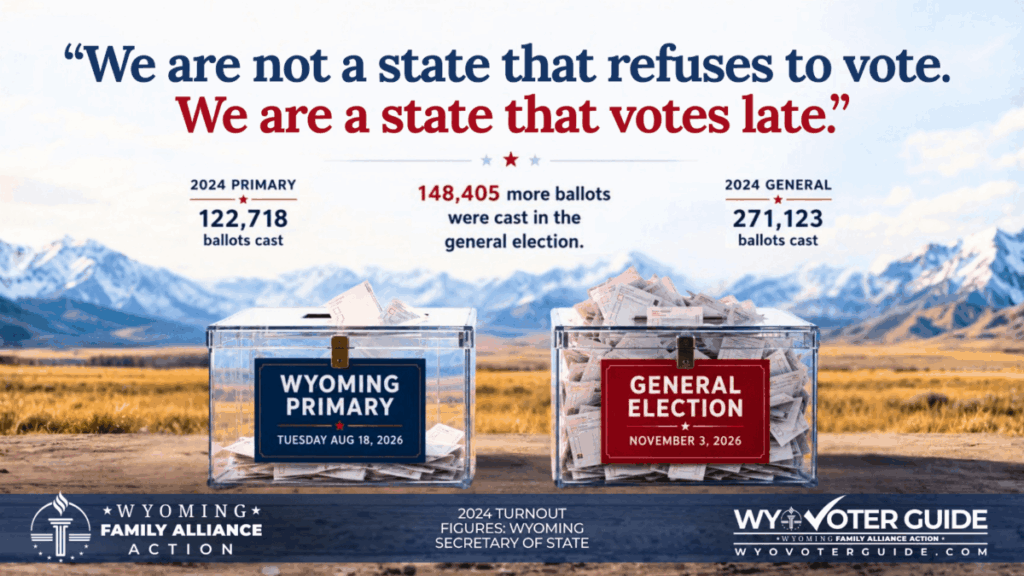
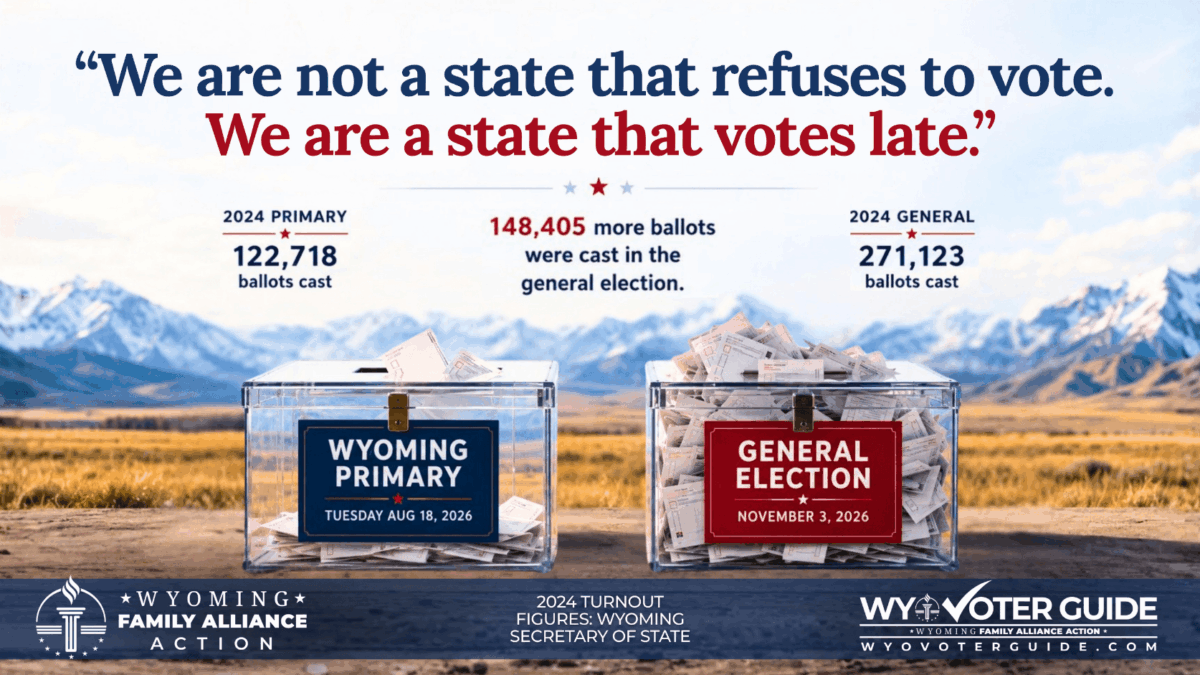
In 2024, 271,123 Wyomingites voted in the general election. Fewer than half that many voted in the primary. The gap is roughly 148,000 people who showed up in November but skipped August. That is more people than live in Cheyenne and Casper combined. We are not a state that refuses to vote. We are a state that votes late.
Paul wrote Romans 13 under Nero
We are not a state that refuses to vote. We are a state that votes late.
Scripture is not shy about civil government. “Let every soul be subject to the governing authorities,” Paul writes. “For there is no authority except from God, and the authorities that exist are appointed by God.” Three verses later, he says of the governing official, “he is God’s minister to you for good.” (Romans 13:1, 4)
It is worth remembering who received that letter. Roman Christians under Nero had no vote, no representation, and no legal recourse. Paul told them to honor an authority they had no hand whatsoever in choosing.
Our position is different and heavier. In a republic, the citizen is part of the ordinary means by which authority is constituted. That does not make us sovereign. It makes us responsible. If God appoints authority, and He has arranged our common life so the appointing runs partly through a ballot box, then what we do with that ballot is not a civic hobby. It is stewardship.
What we are actually told to do
We are not left guessing.
“Therefore I exhort first of all,” Paul writes to Timothy, “that supplications, prayers, intercessions, and giving of thanks be made for all men, for kings and all who are in authority, that we may lead a quiet and peaceable life in all godliness and reverence.” (1 Timothy 2:1, 2)
That is a standing instruction to the church, and the last clause is the one we tend to skip. Paul ties prayer for rulers directly to the conditions under which believers live and work. Who governs is not a side concern. It shapes the ground we stand on. The instruction also assumes something quietly: you cannot pray with any particularity for people whose names you have never learned.
Jesus put the second great commandment plainly: “You shall love your neighbor as yourself.” (Mark 12:31) Paul frames the same duty as a matter of occasion: “Therefore, as we have opportunity, let us do good to all, especially to those who are of the household of faith.” (Galatians 6:10)
Neither passage mentions voting. Given who Paul was writing to, neither could. But the reasoning is not hard to follow. If we are told to do good to our neighbors as opportunity allows, and we live under a government those neighbors and we ourselves help constitute, then a ballot is one of the few opportunities an ordinary person ever gets to do good at that scale.
Proverbs states the stakes without flourish: “When the righteous are in authority, the people rejoice; But when a wicked man rules, the people groan.” (Proverbs 29:2)
The objection worth taking seriously
Some thoughtful believers answer all of this by saying the church has already given politics too much of itself, and spent credibility it will need for something more important. That is not a lazy position. It is held by people who watched congregations fracture over candidates and concluded the cost was not worth it.
They are right about the danger and wrong about the remedy. The problem was never that Christians voted. It was that some of us began sounding like partisans who happened to believe rather than believers who happened to vote. The answer to a disordered priority is to order it, not to abandon the post.
Further down the ballot
Applying that to a governor’s race is not difficult. You have heard of the candidates. Applying it to a state legislative primary is where most of us stall, and that is exactly where Wyoming’s math turns unforgiving.
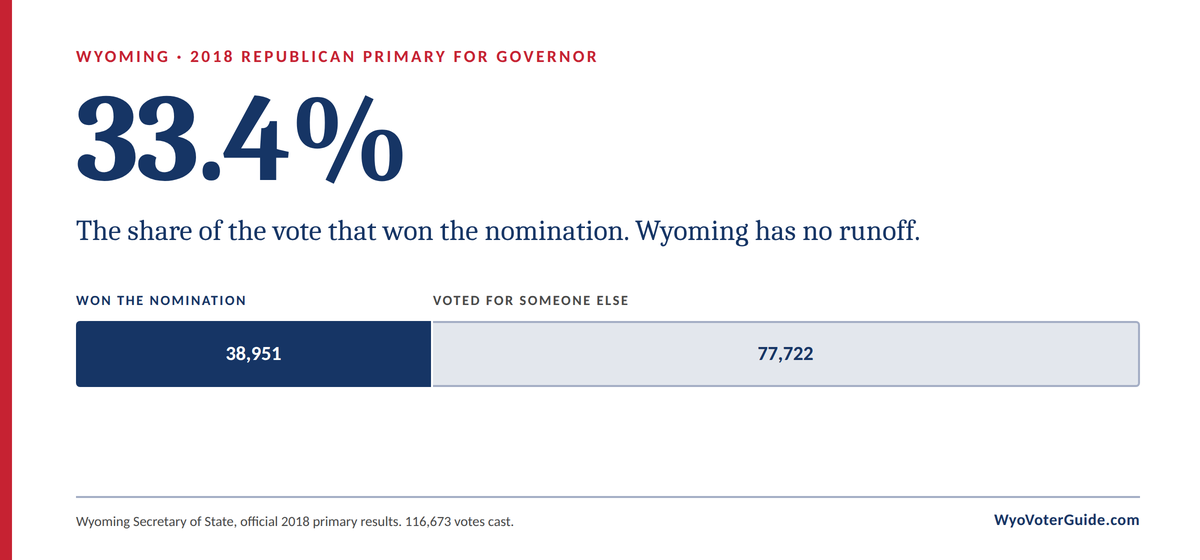
Wyoming has no primary runoff. A plurality wins outright, however small. In 2018, our governor was nominated with 33.4 percent of the primary vote, meaning two of every three Republican voters preferred somebody else. In 2010, the nomination was decided by less than a single percentage point out of 105,960 votes cast. In 2022, a sitting state representative lost his seat by twelve votes, the only Wyoming race that year to require a recount.
Twelve votes. One family, one Sunday school class, one coffee group.
There is a second reason the primary carries the weight here. In a state this Republican, the letter after a candidate’s name tells you very little. It is simply the only label most candidates have a realistic hope of winning under, which means it sorts almost nobody. The label is not the test. The record is. And the primary is the only election where you get to apply it.
The honest reason most of us skip a primary is not apathy. We do not feel prepared, and staying home feels more responsible than guessing. That instinct is a good one aimed the wrong direction. The answer to “I don’t know enough” is not abstention. It is an hour of homework.
The answer to “I don’t know enough” is not abstention. It is an hour of homework.
What we built for you
That hour is what WyoVoterGuide.com exists to save you.
Enter your address and the guide builds your actual ballot, down to your legislative districts. Nothing you will not be voting on. The address is not stored.
For every candidate you can see where they stand on ten statements covering current and recent legislative issues across our four areas of advocacy: Life, Religious Liberty, Family Values, and Education Freedom. Candidates marked their level of agreement and had room to explain the choice in their own words. We received 105. For those who did not respond, we researched their public record and documented what we found, marking a statement “No position found” where nothing clear existed. Where a candidate has served in the Legislature you can also read how they actually voted on the bills behind each statement. Words can be adjusted for an audience. A recorded vote cannot.
One more, with a word about how to use it. Our 2026 primary compilation reports which organizations and individuals have endorsed which candidates, indexed by race, so you can find yours quickly, alongside where each legislator’s record lands against the four areas above. WFA does not endorse in the primary. This is a record of who does. Endorsements are not a substitute for reading the record yourself, but they tell you who is willing to attach their name to whom, and that is worth knowing.
The Voting Info page carries the mechanics: hours, deadlines, what a closed primary means for your ballot, and what to bring if you are not yet registered. You can register at your polling place on Tuesday and vote the same day, and a current Wyoming driver’s license covers everything the law asks for.
If you would rather start where this article started, Honoring God With Your Vote walks through five biblical principles for working a ballot prayerfully. Two pages, free, printable, made to be handed to somebody.
Faithfulness is ours. Outcomes are His.
There is a version of election season that runs on fear. It is exhausting, and it is not ours.
Peter told believers scattered across hostile provinces to “always be ready to give a defense to everyone who asks you a reason for the hope that is in you, with meekness and fear.” (1 Peter 3:15) Notice what we are meant to be ready to explain. Not our anxiety. Not our predictions. The hope that is in us, offered with meekness, to anyone who asks.
Daniel, a young Judean exile newly pressed into Babylonian service and at that moment under a death sentence, blessed God as the One who “changes the times and the seasons; He removes kings and raises up kings.” (Daniel 2:21) He was not making a political observation. He was worshiping, and he had every earthly reason not to. Tuesday’s results will not surprise God, and they will not dislodge Him.
Which is not a reason to sit down. It is the reason we can stand up without panic. We are not asked to secure the outcome. We are asked to be faithful with what is in front of us, and this week, that is a ballot, a little time, and the honest work of finding out who these people are.
Build your guide at WyoVoterGuide.com before Tuesday. Fifteen minutes, and it is the whole assignment.
Voter registration: Wyoming Secretary of State, monthly voter registration report, August 1, 2026. Total registered 272,201; Republican 212,476; Democratic 30,197; unaffiliated 24,970. Party ratio is calculated from those counts.
Turnout: Wyoming Secretary of State, “Wyoming Voter Registration and Voter Turnout Statistics,” revised November 2024. 2024 primary 122,718 ballots cast; 2024 general 271,123 ballots cast. The difference is 148,405.
City populations: U.S. Census Bureau QuickFacts, July 1, 2025 estimates. Cheyenne 66,507; Casper 58,771; combined 125,278.
2018 Republican gubernatorial primary: 38,951 votes of 116,673 cast, or 33.4 percent. 2010 Republican gubernatorial primary: decided by less than one percentage point of 105,960 votes cast. Wyoming Secretary of State official results; 2010 figures cross-checked against Ballotpedia and WyoFile.
2022 House District 2 Republican primary: 1,717 to 1,705 of 3,427 cast, a 12-vote margin, confirmed on recount. Wyoming Secretary of State official results; recount reported by Cowboy State Daily, August 17, 2022.
Wyoming has no primary runoff; a plurality nominates. Senate File 145 (2021), which would have required a runoff, failed on the Senate floor 14 to 15.
Last Democrat elected governor of Wyoming: Dave Freudenthal, November 2006. Last Democrat elected to a Wyoming statewide federal office: Teno Roncalio, U.S. House at-large, November 1976.
Election mechanics and the 2025 proof-of-citizenship and residency requirement: Wyoming Secretary of State 2026 election calendar and key dates.
Scripture quoted from the New King James Version.