by Nathan Winters
President & CEO of Wyoming Family Alliance
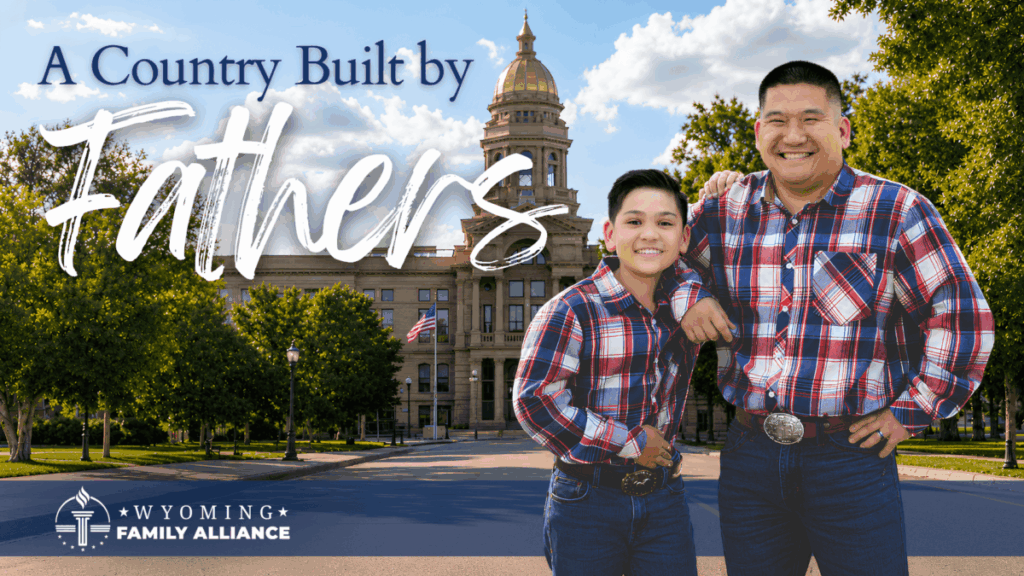
Photo: U.S. Navy Chief A.J. Riester is the proud father of Gabriel (pictured, age 12), Mischa (age 17), and Violet (age 15), and is the husband of Wyoming Family Alliance’s Pro-Life Liaison, Krista Riester.
A Country Built by Fathers
The Revolutionary War was not going well when, five years after the battles of Lexington and Concord, John Adams went to Paris to help secure a diplomatic end to the war.
As Adams traveled the French countryside and visited the palaces and gardens of French nobility, he longed for the day when war could be set aside so that he could explore the numerous interests his reading and studies had presented to him.
Adams captured both the longing and the duty when he wrote home to his wife, Abigail. “I must study Politics and War so that my sons may have liberty to study Mathematics and Philosophy… My sons ought to study Mathematics and Philosophy, Geography, and Natural History, in order to give their Children a right to study Painting, Poetry, Music, and Architecture.” (Spelling modernized.)
Adams understood something that every good father eventually learns: each generation is a steward of the next.
“The American founding was not accomplished by comfortable men seeking convenience. It was built by fathers who sacrificed.”
John Adams loved art, architecture, literature, and the beautiful things of civilization. He once wrote that he could “fill volumes” describing Europe’s great cathedrals, paintings, sculptures, and palaces. Yet he believed his duty demanded something else.
His generation had been assigned the difficult task of politics and war. They did not choose the times in which they lived. They simply accepted the responsibility of defending liberty so that their children and grandchildren might inherit something better.
A Founding Built on Sacrifice
The American founding was not accomplished by comfortable men seeking convenience. It was built by fathers who sacrificed.
Many of them left behind farms, businesses, and families. They endured uncertainty, financial ruin, and the possibility of death. They signed their names to a declaration that could have sent them to the gallows.
They crossed icy rivers, slept in tents, and buried friends. They carried burdens that they hoped their children would never have to bear.
Why? Because good fathers are wired to think beyond themselves.
A good father asks not merely, “What do I want?” but “What kind of world will my children inherit?” He understands that every sacrifice today is an investment in tomorrow.
The Battle Before Fathers Today
That same calling belongs to fathers in our own generation.
Our battles look different from those of John Adams, but they are no less consequential. The struggle before us is not fought on the fields of Lexington or Yorktown. It is fought in our homes, churches, schools, and the public square.
It is a battle over truth itself. Will our children inherit a society that still understands the dignity of human life? Will they know that marriage and family are good gifts from God? Will they grow up with the freedom to live according to their faith and speak what is true without fear?
These questions are not abstract political theories. They are profoundly personal. They concern the world our children and grandchildren will inhabit.
Every generation is tempted to withdraw from these responsibilities. It is easy to become cynical. It is easy to conclude that someone else will fight the battle. It is easy to retreat into private life and hope the storm passes.
But storms rarely pass on their own.
The founders understood that liberty is never self-sustaining. Every blessing that is left untended eventually deteriorates. Every inheritance that is neglected eventually disappears. Freedom survives only when ordinary men and women willingly accept extraordinary responsibilities.
That is especially true of fathers.
Children need fathers who are willing to do difficult things. They need fathers who tell the truth even when it is unpopular. They need fathers who protect their families, cultivate virtue, and engage their communities. They need fathers who understand that love sometimes requires sacrifice and that courage often demands standing against the spirit of the age.
“But our duty is no less demanding… We are called to preserve a moral and spiritual inheritance worthy of our children.”
Perhaps our generation’s assignment is not to study politics and war in precisely the same way that John Adams did. But our duty is no less demanding. We are called to defend those permanent truths and enduring institutions that make ordered liberty possible. We are called to preserve a moral and spiritual inheritance worthy of our children.
What Will Our Children Say?
Someday, our children will tell the story of our generation.
May they be able to say that when confusion spread and truth was challenged, their fathers stood firm. May they say that we did not shrink from hard duties or surrender to despair. May they say that we loved them enough to sacrifice our comfort for their future.
And perhaps, by God’s grace, because we were willing to fight for what mattered, our children and grandchildren will enjoy the freedom to build, create, worship, and flourish in ways we can scarcely imagine.
That has always been the work of fathers: accepting the difficult duties of today so that their children may enjoy a better tomorrow.