
The Supreme Court sided with Wyoming. It also left the hardest question to us.
By Nathan Winters, President & CEO, Wyoming Family Alliance
On the last day of June, as Americans prepared to celebrate our 250th anniversary as a nation, another celebration unfolded. The Supreme Court handed girls and women a hard-won victory, affirming the right of states to protect girls’ sports from the invasion of boys.
What Title IX Was Always For
For many years, families across the country watched a vital right slip away. Title IX, established in 1972, was created to open opportunities for girls, ensuring that a daughter would have the same chance to join a team, earn a medal, and win a scholarship as any son. That promise rested on a biological truth: boys and girls are different, and sometimes fairness means treating them differently.
When courts and school districts began erasing that distinction, they were not expanding opportunities for women. They were quietly taking them away.
Why the Court Said Yes
Writing for the majority in West Virginia v. B.P.J. and Little v. Hecox, Justice Brett Kavanaugh recognized what every coach already knows: men and women have inherent physical differences—height, weight, strength, speed, endurance, jumping ability—that are relevant to athletic performance. Those differences create real safety risks in contact sports and undermine competitive fairness in nearly every sport. That is why schools have long maintained separate teams, and why record books keep a women’s column.
Kavanaugh did not frame this as contempt for anyone. He wrote that transgender athletes’ “desire to compete warrants respect,” and that “no student-athlete on either side of the issue, whether a biological female or transgender, deserves to be ostracized or vilified.” The holding was measured, not vindictive: limiting girls’ teams to biological females, the Court held, is “substantially related” to the states’ genuine interests in “safety and competitive fairness.”
Consider the girl who got up before dawn for years, who pushed herself to the edge of her limits for the chance to stand on a podium. To ask her to hand over a roster spot, a race, or a state title to a male is to tell her that her effort never really counted. Sports, Kavanaugh observed, “are highly competitive and generally zero sum. At almost every turn, someone wins and someone loses.” When a male takes a spot on a girls’ team, a girl goes home.
When a male takes a spot on a girls’ team, a girl goes home.
The Court also took up the argument that puberty blockers or hormones erase the difference. Kavanaugh explained why individualized exemptions are unworkable, and who ought to be making these calls. Legislatures and schools, he wrote, are “better equipped—and under the Constitution, are the more appropriate entities—to assess the competing medical and scientific considerations and draw appropriate lines.”
That is not extremism. That is self-government.
What the Court Did Not Decide
Honesty requires a word about the limits of this ruling, because our opponents are counting on us to overstate it.
The Court decided athletics. It did not decide locker rooms. Justice Kavanaugh was careful to confine the opinion to sports, and the question of whether schools may keep girls’ locker rooms, showers, and restrooms for girls remains open in the lower courts.
The Court decided athletics. It did not decide locker rooms.
Critics warned that protecting these spaces was cruelty dressed as fairness. But make no mistake about what the Court has handed us. It affirmed that biological sex is real, that it matters, and that protecting girls’ safety and privacy is a legitimate interest a state may act upon. That reasoning does not stop at the gymnasium door.
And the principle at stake there is not complicated. Locker rooms are not a small detail. They are places where teenage girls, at their most vulnerable, are entitled to modesty, dignity, and freedom from the presence of male bodies. A daughter who says she is uncomfortable undressing in front of a biological male is not intolerant. She is telling the truth about a boundary that generations understood without argument. Parents are right to insist on it, and girls should never be shamed for wanting it.
That fight is not over. It is ours to win in state houses and on school boards, where it belongs.
Even the Dissenters Agreed
It is worth remembering how broad the agreement really is.
All nine justices, including Justices Sotomayor, Kagan, and Jackson, agreed that these laws do not violate Title IX. The 6–3 split came only on the constitutional question. On the meaning of the very statute that governs school sports in America, the Court was unanimous.
Idaho passed the first such law in 2020, and twenty-seven states now draw this same line. So do the NCAA, the U.S. Olympic and Paralympic Committee, and the International Olympic Committee. Justice Clarence Thomas, concurring, stated it plainly: “Sex is an immutable ‘biological’ characteristic; it is binary.”
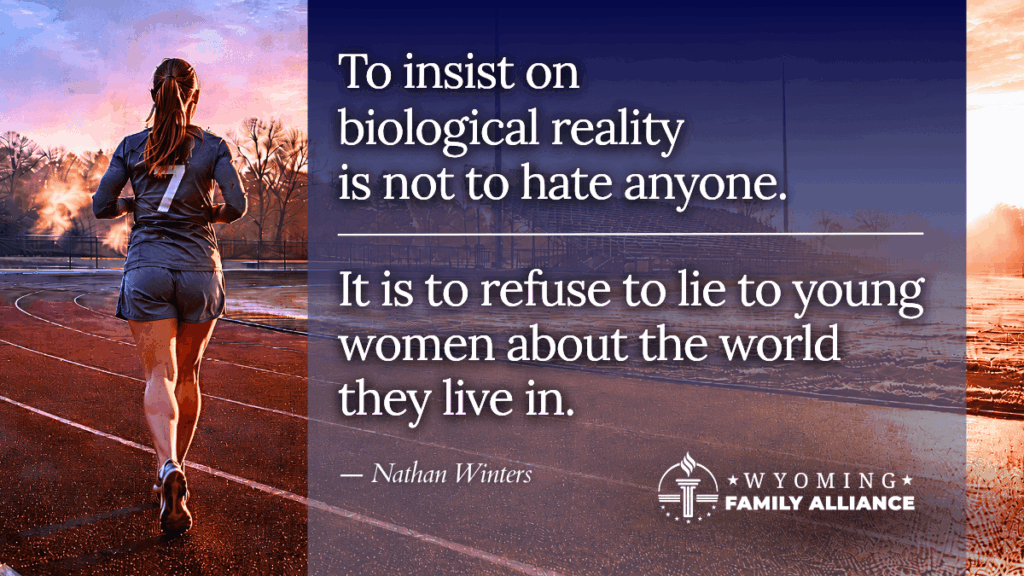
To insist on that truth is not to hate anyone. It is to refuse to lie to young women about the world they live in.
Wyoming Was Already There
Wyoming did not wait for the Supreme Court.
In 2023, the Wyoming Legislature passed protections for girls’ interscholastic sports in grades seven through twelve. It was not the easy vote. Governor Gordon declined to sign it, allowing it to become law without his signature. He said he agreed with the goal of fairness in women’s sports, but called the bill “overly draconian” and “discriminatory.” In 2025, lawmakers extended those protections to collegiate athletics.
On June 30, the Supreme Court answered that charge. What Wyoming’s Legislature passed was not draconian. It was constitutional, and nine justices agreed it did not violate Title IX. Governor Gordon welcomed the ruling.
That is what courage in a legislature looks like: casting the hard vote years before the vindication arrives, because it is right. Because of great legislators and an alliance of men and women to back them, our state protects its girls from the harms of gender ideology.
The Work Ahead
For families told for years that defending their daughters was hateful, this decision offers relief and vindication. The Supreme Court examined the law, the science, and the Constitution, and affirmed what most Americans already knew: girls deserve their own teams.
The victory is real. It is also incomplete. The Court has told us plainly that these lines are ours to draw: in our legislature, in our school districts, in our athletic conferences. That is an invitation, and it is a responsibility.
For nearly four years, Wyoming Family Alliance has been at the forefront of this battle to defend girls’ sports. It is not the only fight we take up for Wyoming families, but we have never walked away from it, and we will not walk away now.
The Court has drawn the line. Holding it is the work of legislators who will not blink, school boards that will not flinch, and parents who know what the law now permits them to ask for. We cannot be in every room in this state. We can make sure that no one who stands up in one of them stands there alone.
That is what your support protects: a girl, somewhere in Wyoming, who gets up before dawn and finds the field still fair when she arrives.
Stand with us.
The Court did its part. The next part is ours, and it happens in Cheyenne, not Washington.
Donate